.png?width=170&height=44&name=MillerZell_Outline_Black_NO-Tagline_CLEAN-01%20(1).png "Miller Zell")















CES 2026 in Las Vegas once again proved why it’s the world’s premier stage for innovation. As the ultimate global showcase for emerging technology, the event offered no shortage of bold ideas, inspiration and moments that made us excited about what’s coming next.
So, what were the lead stories, most interesting products and developing trends this year?
Those are questions we asked Miller Zell’s Virginia Lewis, VP Account Development & Digital Solutions, and Patrick Neff, VP Account Development Retail & Client Solutions.
MILLER ZELL: Before we get into the practical, let’s talk “wow” factor. What was the coolest thing you saw at CES?
Virginia Lewis: This is the hardest question because there was so much cool stuff.
It’s personal because of my father-in-law, but there’s this thing called the Hypershell X. It’s a consumer-grade exoskeleton. Their primary market is athletes and secondary market is seniors. It literally gives you strength in your legs. It allows you to get, like, 20 or 30% more strength in your legs, so you can use it for running, for hiking or to help people who are limited in their ability to move around their living spaces.
The other thing that I thought was really neat was the Lego SMART Play system. The smart bricks and the smart minifigures with the smart tags… that whole system was really neat.
And then robots everywhere. Boxing, playing ping-pong, making ice cream. There was one that was doing Tai chi, one folding laundry and many were being shown doing manufacturing work.
Preview of Rubik’s WOW Cube 2x2 live from CES 2026. Video used for commentary/educational purposes. All rights belong to the original creator Avionyx.
Two more products caught my eye. The Rubik’s WOWCube. It’s got, like, 100 different games on it, and it just hearkened back to my childhood with the Rubik’s Cube.
And then Ollobot, which is a family pet, they’re launching on Kickstarter and it grows with your family. It also records family moments, and it checks in on the emotion of your kids. And then it will also edit the video that it’s recording. It’s really, really neat.
Patrick Neff: There were a couple of key themes from a health-tech perspective and what health tech is all about.
There are new wearables, and this year they were more purposeful, with early detection a big theme. There was a body scan scale and a lot of allergen and health test devices, but they are more about promoting portable longevity health tracking versus just the right-now numbers.
It was “wow” to me because it is showing a shift in consumer behavior from just telling me how many steps I did today to “Should I go get screened for something important?”
Another “wow” was the way OLED screens have evolved, specifically with laptops. So there was a Lenovo OLED screen that they announced this year for a 15-inch laptop. You open it up at the hit of a button. The OLED then rolls outward, and you get up to a 24-inch screen out of it. It literally expands, which will be great for gamers, creatives, for architects, for whoever needs a little bit more screen landscape and it will get bigger over time.
Another wearable were the Meta glasses. They can respond and react to you and give you kind of real-life, real-world connectivity, sharing information right on the lens.
MILLER ZELL: Miller Zell is in the business of providing effective, efficient solutions for clients with branded environments — retailers, banks, QSR and the like. Give me one or two things you saw that might immediately interest our clients?
Neff: I’ll just start by saying that one of the things that Virginia and I look at when we’re at a consumer type show is that you witness how a bunch of brands compete for engagement — just like stores do.
How they do that is, first, by using big, dramatic things, like hologram fans and huge LED displays. But we look more closely at booth design and the overall product showcase. How well do they present their products and grab attention? For example, there was a small manufacturer that was displaying cell phone cases that were all mag safe. They displayed them by literally magnetically sticking them to a pegboard wall. Everyone smiled as they took down the cases from the display to look at them. Huge value in that.
That’s about maximizing a confined space — how do I show off the most product in the best way? Those are things that we took pictures of. I think there were some high-end, low-effort displays that really connected.
Lewis: I agree. We took a lot of pictures of fixtures and event displays because we were seeing a lot of well-done storytelling. There were also digital displays that responded to factors like time of day, store-traffic levels, things like that. Those aren’t entirely new, but that’s one of the things that our clients can consider. It just depends on where they are in their cycle with their displays.
I also met with someone dealing with fast fashion and its high levels of waste. They want to help customers receive clothes that are going to fit by using smart mirrors and then ship it directly to you. It’s basically a fast-tracked, tailored fit, instead of, say, me getting a size that doesn’t fit and then I never wear it, eventually throwing it away. They’re working with brands on this actual platform and technology.
MILLER ZELL: Going to assume AI was a huge presence in a variety of forms at CES. Based on what was being said at CES and your own thinking, where is AI going to make its biggest impact over the next six to 12 months?
Lewis: Yes, that was an overarching theme. AI was embedded into just about everything in one way or another at CES. It’s not just a layer on top either, as it was in the past. It’s now embedded into everything.
There’s a shift in screens that are not just part of a display experience, but it’s screens that understand what’s happening around them. We saw that coming last year and the year before. It’s like these sorts of environment-aware, AI-assisted experiences that help the customer inside the store and help the retailer better understand and serve that customer. It’s about precise data gathering and data interpretation turned around in real time and immediately useful within specific parts of store environments.
Neff: A lot of retailers want to use AI to make associates more productive and capable in front of guests, making their jobs better and them better at their jobs.
They use device alerts and recommendations that are now part of their service experience as they’re assisting customers. They’re basically enabling employees with a lot more AI-driven tools. They are very focused on how this tech feels human and not robotic and what that experience looks like, which is something that all our clients could use. We were just talking this morning about how specific clients could be potential use cases for these AI enablements.
There were a lot of AI agents and presentations on how AI agents will help promote, drive and manage important tasks like, say, BOPIS orders. It’s all coming fast for a lot of retailers because they’re seeing basket size increases in some of these early tests.
What’s interesting is that not long ago, people were talking about technology causing the death of brick-and-mortar retail, but now we’re seeing technology leading a brick-and-mortar resurgence.
There was a big focus on community and experience, not just fulfillment. Physical stores are the focus for community and loyalty, and you’re seeing loyalty programs grow in size, sophistication and customer engagement.
“What's interesting is that not long ago, people were talking about the technology causing the death of brick-and-mortar retail, but now we’re seeing technology leading a brick-and-mortar resurgence.”
It’s also part of an interesting conversation around how we do store design. Zoning and experiential layers explicitly drive customer engagement and purchasing and basket size, and AI is a part of solutions here.
These spaces within spaces present vignettes that include products but also operate as community nodes that include things like events, services and education for customers. These are things that retailers have tried for a long time but maybe gave up on because they didn’t see revenue.
Retailers are connecting their merchandise, their supply chains, their stores together, process-wise. A great quote: “When your upstream is smarter, the floor experience becomes simpler and more curated.” And I think that sums up what AI enables. It’s not necessarily in your customer’s face; it’s the upstream.
Data connectivity between all of those touchpoints will drive a smarter employee and a more curated experience for self-service customers, as well as a better layout and a better merchandising strategy because you’ve got these data-driven insights via these AI flows.
They call it “horizontal intelligence” in layout and storytelling and inventory presentation.
Lewis: AI is so integrated in everything. From the retailer standpoint, they’re trying to be smart about how they’re investing their dollars. They don’t want to go all in; they want to go in thoughtful phases.
It’s not hesitancy, but they want to do it in a smart way. I think a little bit to Patrick’s point — they want to do it to enable their employees and to make it better for their customers.
I think AI is going to show up in ways that enable them to do their jobs better and smarter. I think you’ll see them invest, kind of, like Walmart does. They’ve done a lot in logistics and manufacturing and ways to get products to the customer. That’s where they’re investing in AI right now. I think that’s the way that you’re going to see it show up this year. I don’t think it’s going to show up in ways that are incredibly visible to the consumer. I think it’s going to be in the background.
MILLER ZELL: Touched the AI base. But we’ve also been reading a lot about robots, and many CES stories seemed to hint we’re closing in on true robotic solutions. What’s your take on this? Are robots about to enter our lives, both commercially and residentially?
Neff: They are. For one, I would say that robots in the form of drones will expand tenfold in 2026. I think we’ve seen that from a Walmart perspective, but there are start-ups for drone delivery robot-like systems that are becoming more and more prevalent.
They’ve gone through live field testing. I think it was two years ago that Virginia and I saw them announce the pilot tests for drone delivery with Walmart. So, I think that will be the biggest piece of robotics that would be more customer facing.
I would say from a warehousing, logistics perspective, that’s already in play. Quite frankly there’s already robot AI, such as enabled robot vacuums that were marching around the Cosmopolitan hallways while the show was going on. Everyone was stopping and making comments about it. People were bringing up references of Rosie from The Jetsons.
Lewis: I’m laughing remembering that. Just like AI, it’s also about robotics behind the scenes, in distribution centers, fulfillment centers, back of the house and things of that nature. For example, what a great thing robots could be for lifting and moving, especially heavy products that normally require two people to lift.
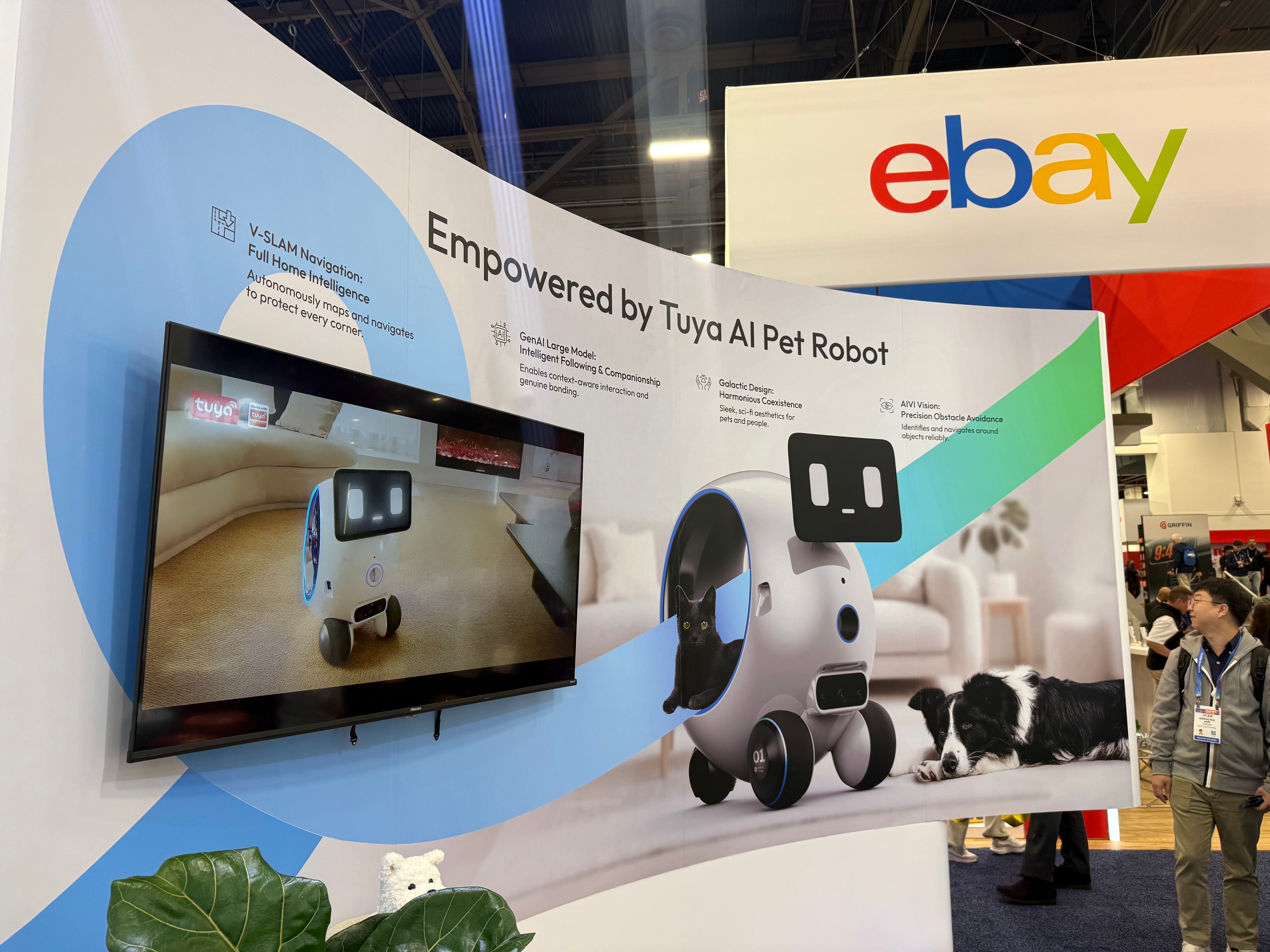
With the true consumer home experience, I would say it’s more a smaller baby step approach.
We saw an AI robot cat box and a robot that looks like a wheel that has a camera and a display on it that interacts with your pets and plays pet videos that are calming. It has a place inside of it where a cat can jump in and lie down while they’re rolling around and roaming the house kind of thing, making them feel less anxious and lonely. So that’s where I think we’ll see a lot of that.
MILLER ZELL: Finally, what was the overall vibe at CES? Is 2026 going to be a year of advancement and opportunity, both for retailers and technology? Or are most folks still taking a “wait-and-see” stance on the economy and cutting-edge tech?
Patrick: That’s a great question. I would say that there’s two sides of the fence. There’s enthusiasm as always about what’s new. But there’s also some ambivalence with all the AI, with all the products that are driving expenses and using a lot of energy. Many of these products have uncertain actual value, as solutions maybe to problems that don’t exist.
Some of that is cool, but it’s also why I’m spending $800 for a memory card right now for my computer. And why I’m spending $3,000 for my graphics card. Consumers are focused now on affordability, and these sorts of things are out of reach for most people.
But I also would say there is a very big positive shift toward human-centric, positive devices and products I saw while judging about 80 products in CES Innovation Awards.
“There was a lot of intriguing technology at CES, and it’s about envisioning what’s useful now and how to integrate it into your store development, particularly at scale.”
Lewis: I would say that about 90% of the products had genuine human-centric use. The way that they enabled an AI, it was with the intent of actually making your life more efficient and better with some fun rolled in.
I’ll also say I’ve never seen this show be so impacted by creators. This show had a giant creator space. There was this simple clock, a rectangle analog clock. But it also was animated with this E-link picture frame, and the content was really artist-driven, with animated shows or drawings or paintings that you could interact with or even download.
It was giving creative artists a new platform to go and submit their work for people to see and purchase.
As for a vibe for retailers, it’s always about moving quickly and efficiently with solutions that create ROI. There was a lot of intriguing technology at CES, and it’s about envisioning what’s useful now and how to integrate it into your store development, particularly at scale. I felt I saw more curiosity and enthusiasm than stress and skepticism.