.png?width=170&height=44&name=MillerZell_Outline_Black_NO-Tagline_CLEAN-01%20(1).png "Miller Zell")














Prefer listening? Press play above to listen on the go.
This audio is auto-generated. Please let us know if you have feedback.
Retail moves fast. Your problem-solving and customer experience upgrades should too.
Customer wants and needs evolve quickly. Nurturing solution speed is an operational requirement that becomes a competitive advantage if you do it better than retailers in the same or adjacent categories.
Retailers who win don’t avoid problems. They solve them faster and better than their competitors, transitioning from a slow-moving bureaucratic model to a culture of constant analysis and improvement seeking.
This rapid execution loop starts with focused thinking on “How do we improve this?” for every aspect of a store environment or customer touchpoints. This both prevents problems from happening and meets those that do arise with a process to expedite solutions.
Here’s how it works:
1. Avoiding the retail diagnosis gap
2. The four pillars of the retail problem-solving loop
3. Agile partnerships that optimize process and execution

Avoiding the retail diagnosis gap
Most retailers are better at identifying something that is wrong than understanding precisely why.
Sales data flags underperformance. Foot traffic metrics show drop-off. Customer feedback surfaces dissatisfaction. But the gap between signal, diagnosis and cure is where time is most commonly lost.
The traditional retail development model often struggles because these issues move through distinct silos with divergent thinking.
As in: An issue is noted, teams meet and chat, hypotheses are debated, data pulls are requested and weeks pass before anyone agrees on the actual problem cause, let alone a solution.
The diagnostic phase should be measured in days, not weeks.
Closing this gap requires both a structural and cultural commitment. You need a diagnostic framework that alerts relevant stakeholders with real-time data and problem-solving procedures with clearly defined next steps.
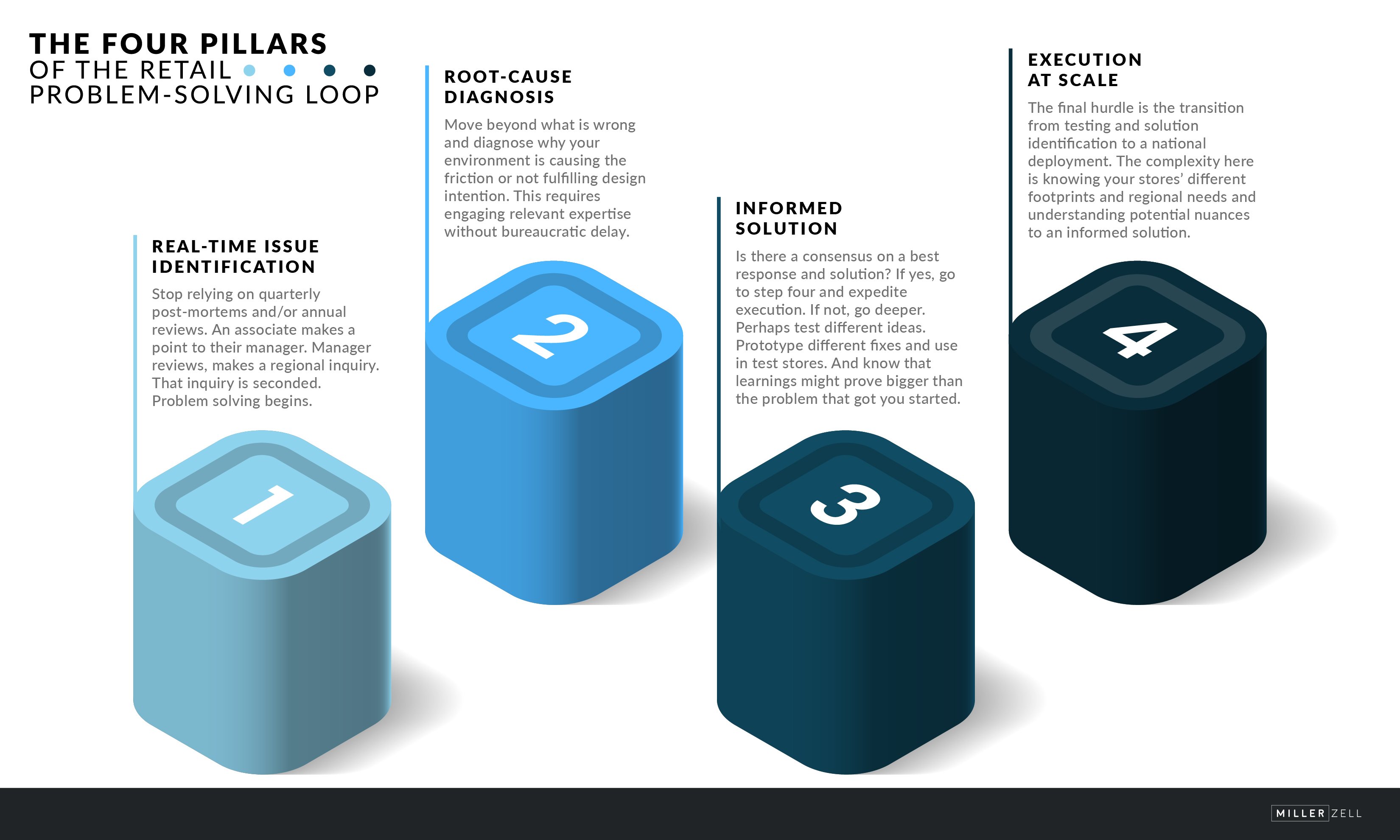
The four pillars of the retail problem-solving loop
Conceive and operationalize a fast-moving problem-solving process built around four connected stages: issue identification, diagnosis, solution development and implementation at scale.
Going deeper:
- Real-time issue identification: Stop relying on quarterly post-mortems and/or annual reviews. An associate makes a point to their manager. Manager reviews, makes a regional inquiry. That inquiry is seconded. Problem solving begins.
- Root-cause diagnosis: Why this bottleneck? Why this drop in dwell time? Why this wayfinding failure? Why are customers ignoring this kiosk? Move beyond what is wrong and diagnose why your environment is causing the friction or not fulfilling design intention. This requires engaging relevant expertise without bureaucratic delay.
- Informed solution: Is there a consensus on a best response and solution? If yes, go to step four and expedite execution. If not, go deeper. Perhaps test different ideas. Prototype different fixes and use in test stores. And know that learnings might prove bigger than the problem that got you started.
- Execution at scale: The final hurdle is the transition from testing and solution identification to a national deployment. The complexity here is knowing your stores’ different footprints and regional needs and understanding potential nuances to an informed solution.
By the way, this is an ideal potential entry point for agentic AI into your store development process. While it still requires human supervision, it can both diagnose and solve problems as well as efficiently analyze your inputs, questions and processes.

Agile partnerships that optimize process and execution
Silos vs. problem solving. Bureaucracy. Perspectives at loggerheads and cost uncertainty. These issues often linger and create friction as a hoped-for solution moves toward execution at scale.
Speaking of AI, one of its platforms wrote, “Execution at scale is where agile partnerships become essential.” True. But agile retail partnerships arrive at program scaling with confidence and low stress because of transparent communication during every step of the process.
Your store development partners should function as extensions of your internal teams, providing valuable feedback and information throughout the process, allocating resources and solving problems collaboratively in real time. It’s about connecting your brand promise into real-world execution and using applied knowledge and experience to maintain design intent and maximize the scaled impact of this solution.
“Speaking of AI, one of its platforms wrote, [Execution at scale is where agile partnerships become essential.]”
And then maintaining a dialogue that inspires the next round of innovation. In fact, collaborative partnerships support the creation of pre-qualified solution libraries, where pre-approved design and operational solutions can deploy faster because the approval process has already happened. The solution sometimes is pulled rather than newly invented because not every problem requires a customized response.
This is about being outcome driven instead of task driven. Retail vendors who still operate on rigid timelines or fragmented communication structures are so 2019. Agility is about more than production capacity. Agile partners help retailers accelerate testing, approvals, fabrication, logistics and installation, so solutions move into stores faster.
Store projects often evolve and challenge timelines, but agile partners can pivot without derailing rollout schedules. They also help reduce the costly lag between decision and implementation.
For some retailers, the biggest delays are not caused by internal strategy debates. They are caused by vendor execution bottlenecks, which can severely damage multi-site rollouts and remodels.
This is where efficient partner relationships become a direct competitive asset.

Speed with confidence: Uplifting customer and associate experiences
Ultimately, retail store development is becoming less about maintaining perfect long-term plans and more about building organizations capable of rapid adaptation.
Retailers need systems and partnerships designed for continual problem solving, continual improvement and continual execution.
These systems improve your customer experience and often support your associates and improve retention. They even will feel invested in the process.
The brands that win will not be the ones that avoid disruption. They will be the ones that identify issues faster, make decisions more quickly and execute solutions at scale before their competitors.